
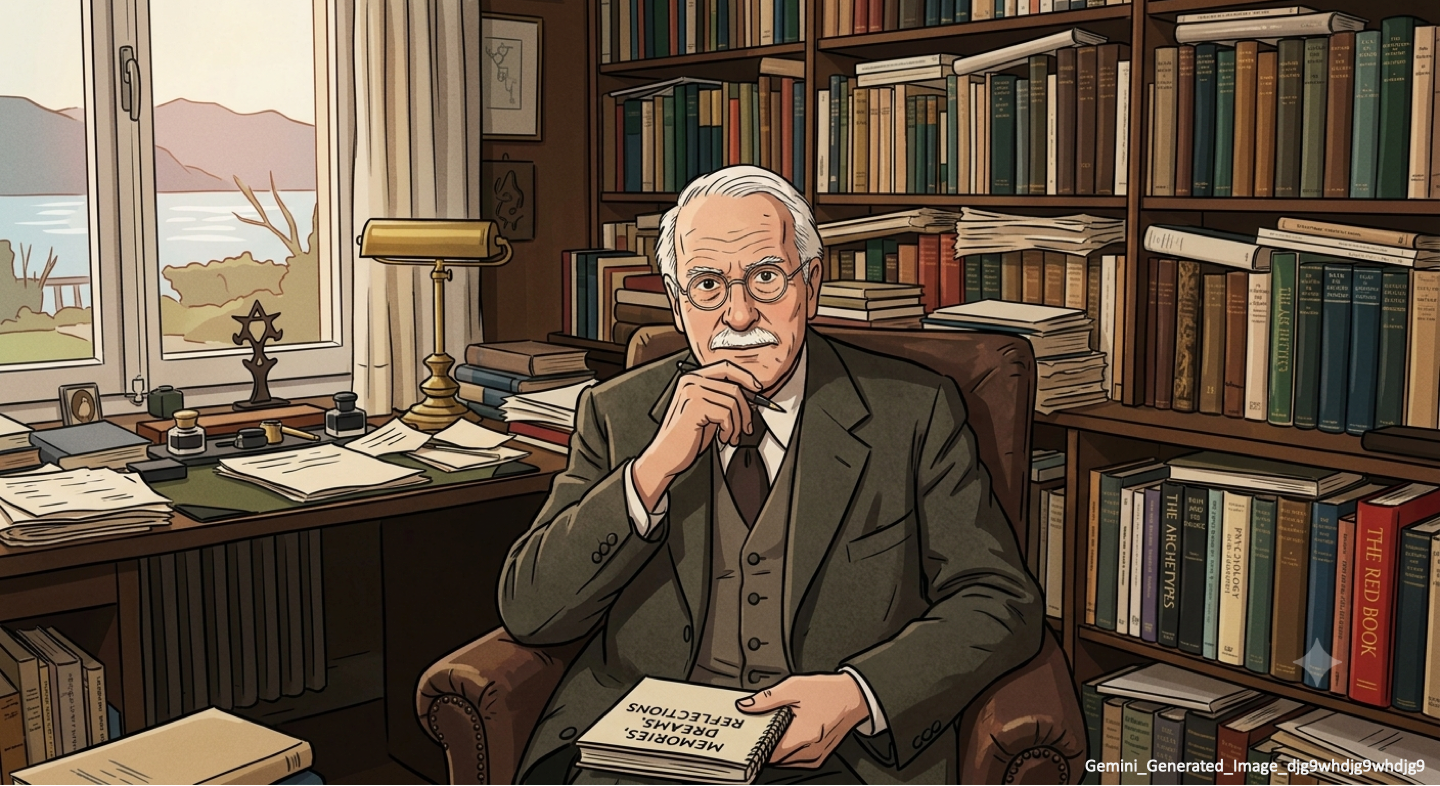
Use of Archetypes in Healthcare
James F Fleck, MD, PhD
Anticancerweb 13 (07), 2026
Carl Gustav Jung (1875–1961) described the human mind as collective and identical across all individuals, owing to its impersonal nature. This collective unconscious is grounded in innate, amorphous archetypes capable of giving rise to a vast array of images, symbols, and behaviors. They typically appear in myths, dreams, and most forms of artistic expression throughout human history, representing essential human experiences.
The experiences each person accumulates throughout life foster individuation. Consequently, despite the relatively small number of innate and amorphous archetypes, they can give rise to countless behavioral expressions. There is a subtle integration between inherited components and epigenetic factors in personality development. Interestingly, a universal pattern appears to exist—marked by synchronicity between human beings and natural events—revealing their phenotypic plasticity.
Jung anticipated concepts such as Gestalt laws, conceptual organization, fractals, and AI-based pattern recognition. All these elements are interconnected, as they involve the classification and identification of data samples based on their similarities and reproducibility. This process is fundamental to how human beings perceive and understand the manifestations of nature and human behavior. From my perspective, they constitute highly refined, reductionist heuristic models.
A recent article by Erik Goodwyn, published in the Journal of Analytical Psychology, clearly outlines Carl Jung’s initial view on the importance of archetypes in enhancing healthcare. "Archetypes are universal organizing themes or patterns that emerge independently of space, time, or person. Appearing in all existential realms and at all levels of systematic recursion, they are organized as themes, which Jung described as the potential world outside of time, and are detectable through synchronicities".
Whenever a patient arrives at my office, I seek to identify their dominant archetypes within the first few minutes and, naturally, focus all my attention on finding the best way to approach their specific profile. For ethical reasons, I cannot publish real cases; however, by drawing on archetypes, I have managed to create fictional stories that accurately reflect the real world.
In the book section of this site, you can follow the clinical narratives of fictional characters as they deal with their ailments. The stories are structured as episodes (vignettes) that follow a narrative arc. In each episode, the reader experiences patient's emotional interactions across three orthogonal axes: their amorphous archetypes, the interface with the physician, and environmental forces. To foster engagement, the physician adopts a passive and welcoming attitude. The physician reads patient's psychological state, guiding them toward the proposed ideal intervention. The outcome of the patient's interaction with their internalized archetypes is illustrated at turning points. These are opportune moments utilized by the physician to facilitate cognitive intervention and shared decision-making, contributing to the best possible outcome.
Reference:
1. Goodwyn, E: Phenotypic plasticity and archetype: a response to common objections to the biological theory of archetype and instinct. J Anal Psychol, 68: 109–132, 2023
2. Beyerer, Jürgen, et al. Pattern Recognition: Introduction, Features, Classifiers and Principles. 2nd ed., De Gruyter Oldenbourg, 2024
3. Jäkel F.; Singh M.; Wichmann F. A.; Herzog, M. H.: An overview of quantitative approaches in Gestalt perception.", Vision Research, 126: 3–8, 2016
4. W.H. Ehrenstein: Perceptual Organization, In: Neil J. Smelser, Paul B. Baltes: International Encyclopedia of the Social & Behavioral Sciences, Pergamon, 2001, Pages 11227-11231, ISBN 9780080430768.
5. Bunde A, Havlin S: A Brief Introduction to Fractal Geometry. In: Bunde, A., Havlin, S. (eds) Fractals in Science. Springer, Berlin, Heidelberg, 1994
6. Image generated by Gemini, July 12, 2026, Google, in response to the prompts "Please, generate an image of Carl Yung" and "Please, make it as a cartoon."
Authors Info & Affiliations:
James Fleck, MD, PhD: Full Professor of Clinical Oncology at the Federal University of Rio Grande do Sul, RS, Brazil (www.jamesfleck.com)
Please login to write your comment.
If you do not have an account at Anticancerweb Portal, register now.